Chapter 1: The First Payment
I want to start with a confession, because it will save you a hundred pages of theory.
When I joined RideNow as Global Treasurer, the company was already in eleven countries and moving close to two billion dollars a year. It looked, from the outside, like a machine. From the inside it was held together with spreadsheets, good luck, and a man named Tomas who was the only person who understood where the money actually was.
So before I show you the machine, let me show you the day it didn't exist yet: the day RideNow made its first eleven pounds and forty pence. I wasn't there for it. I reconstructed that morning later, from the ledgers and the people who lived it, because you cannot fix what you cannot see, and I needed to understand how the mess began. Almost everything the company would later spend millions to fix was already hiding inside that one payment. They just couldn't see it yet.
Neither, at first, could I.
Camden, 8:52 on a Tuesday
A woman named Priya stands outside a coffee shop in Camden and opens an app that is four weeks old. She wants to get to a meeting in Shoreditch. She taps a button. A car three streets away lights up on a driver's phone. His name is Marek. He accepts.
Eleven minutes later Priya gets out in Shoreditch. She doesn't hand Marek anything. No cash, no card, no signature. She just walks away. That is the whole magic trick of the business, and it is also the whole problem. Because the ride is over and Marek has been paid nothing, and Priya has paid nothing, and yet £11.40 is supposed to have moved.
Here is what actually happened in the ninety seconds after she walked away, slowed right down. This is the heartbeat. The entire rest of the book is this same heartbeat, getting more complicated as the company grows.
Where the money actually goes
Priya's £11.40 does not go to RideNow. Not first. This is the thing that surprises every founder.
When she signed up, she'd typed in a card number. That card is a promise from her bank that she is good for the money. When she tapped to confirm the ride, RideNow didn't reach into her bank account. It can't. It has no right to. Instead it sent a message to a company whose entire job is to carry that message: a payment processor. Think of the processor as the interpreter standing between a small startup and the enormous, old, suspicious machinery of the card networks.
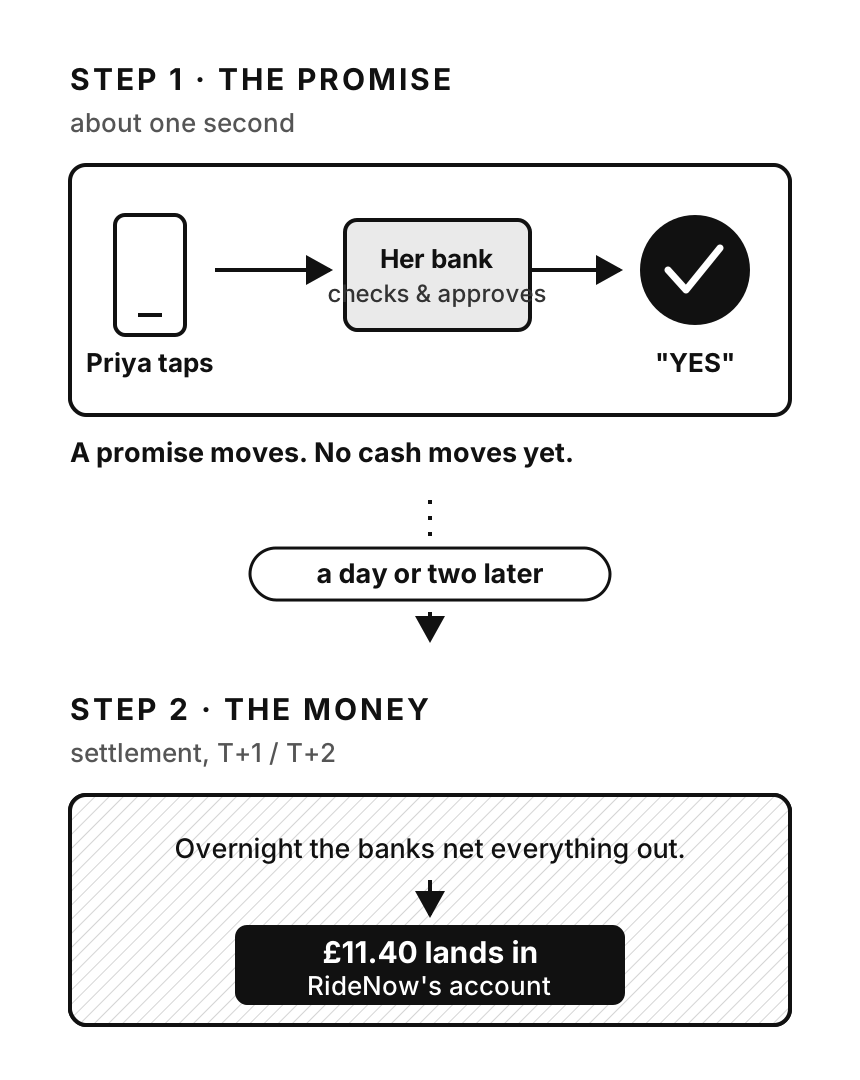
The processor passed the request up to the card scheme (Visa, Mastercard, the names on the card), which routed it to Priya's bank and asked the only question that matters: will you honour this ride from this account? Notice it can't ask for £11.40 yet, because when Priya tapped, the ride hadn't happened and nobody knew the fare. So the app authorised an estimate, and once Priya got out it captured the real £11.40. (When the estimate and the final fare differ, which they often do, you get the first tiny crack that reconciliation will later have to chase.) Priya's bank checked she had the money, checked the card wasn't stolen, and said yes. That yes is called an authorisation. It took about a second, and no money moved at all. A promise moved.
The money itself moves later, and slower than you'd think. That night the schemes and banks net everything out between themselves in a batch. But the cash doesn't reach RideNow's own account until a day or two after the ride: settlement to a merchant is typically next-day or the day after (weekends and bank holidays don't count). Minus fees, which we'll get to, because the fees are where the banks live.
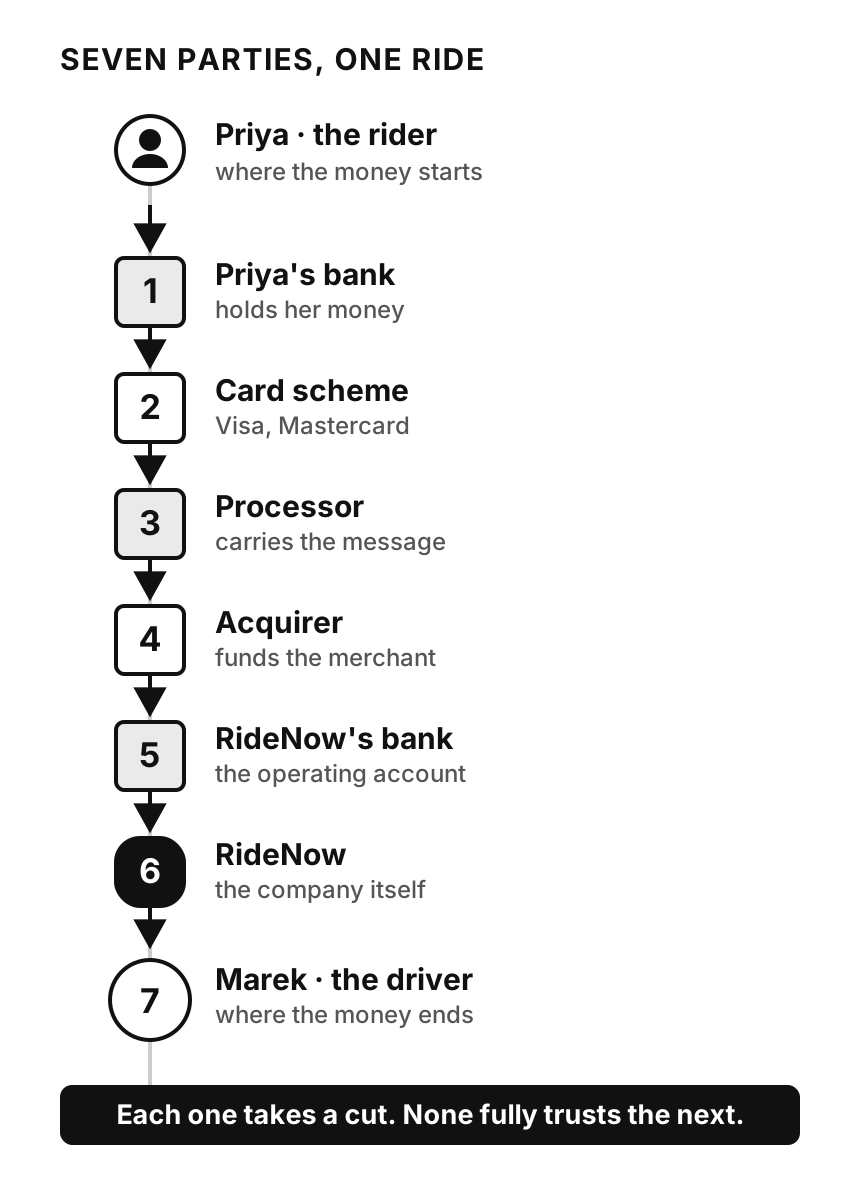
So already, before RideNow has done anything, there's a chain standing between a rider and a driver: Priya's bank, the card scheme, the processor, an acquirer (the party that holds RideNow's merchant account and actually funds it), RideNow's bank, and RideNow itself. Marek makes seven. Nobody in that chain works for free, and nobody in that chain fully trusts the next one. That distrust, formalised and priced, is the financial system.
Which bank holds it, and why that question has teeth
RideNow's money lands in a bank account. Obvious. But which account, at which bank, in which country, turns out to be one of the most expensive decisions a company never realises it's making.
On day one it didn't feel like a decision at all. One of the founders had a business account at a London high-street bank because that's where he already banked. So the £11.40 landed there. Fine.
Except RideNow is going to be in Brazil in eighteen months, and that London account can't hold Brazilian reais, and Brazilian law won't let riders' money leave the country as easily as an app can cross a border. The account that was "obvious" on Tuesday becomes a cage by year two. I've watched companies discover this the hard way, with tens of millions of dollars stuck in a country they can't get it out of, payroll due in another country the next morning. We'll spend a whole season on that trap. For now just plant the flag: the first account you open quietly decides how hard your next ten years will be.
The ledger, or: how the company knows anything
Now the part nobody outside finance thinks about, and everyone inside finance loses sleep over.
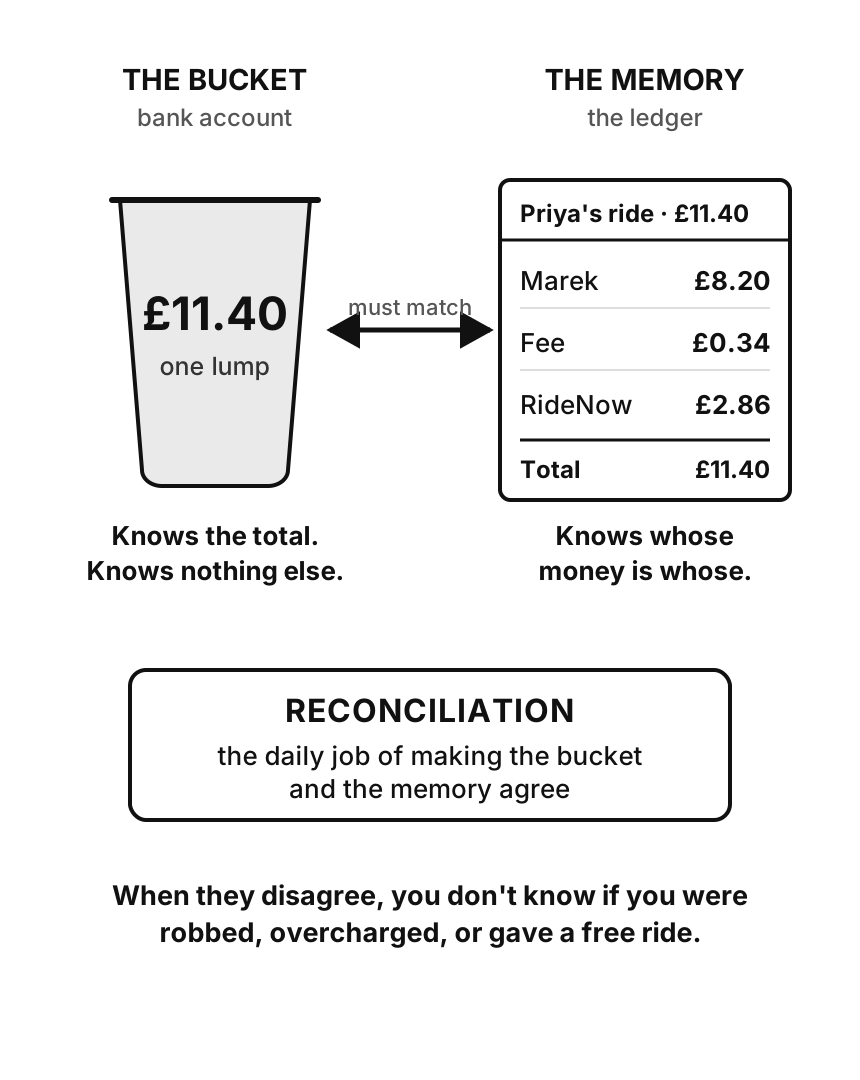
The £11.40 is sitting in a bank account, mixed in with every other rider's money from that day. The bank account knows the total. It does not know that £11.40 of it belongs to Priya's ride, that £8.20 of it is owed to Marek, that £0.34 is a fee, that £2.86 is RideNow's cut. The bank sees one lump. The bank does not care about your business; it cares about a balance.
The thing that knows the breakdown is the ledger, RideNow's own internal record of who owes what to whom. In week four, RideNow's ledger was a spreadsheet a founder updated by hand at night. Every ride was a row. It worked because there were forty rides a day.
The ledger is the company's memory. The bank account is just a bucket of cash. Keeping those two things agreeing with each other, the bucket and the memory, is called reconciliation, and it is the single most underestimated activity in this entire book. When the bucket and the memory disagree, you don't know if you've been robbed, overcharged, or if a rider got a free trip. At forty rides a day you can eyeball it. At forty rides a second, disagreement between the bucket and the memory is how companies lose millions without noticing. Tomas's whole job, years later, would be making the bucket and the memory agree before anyone woke up.
How Marek gets paid, and the promise nobody said out loud
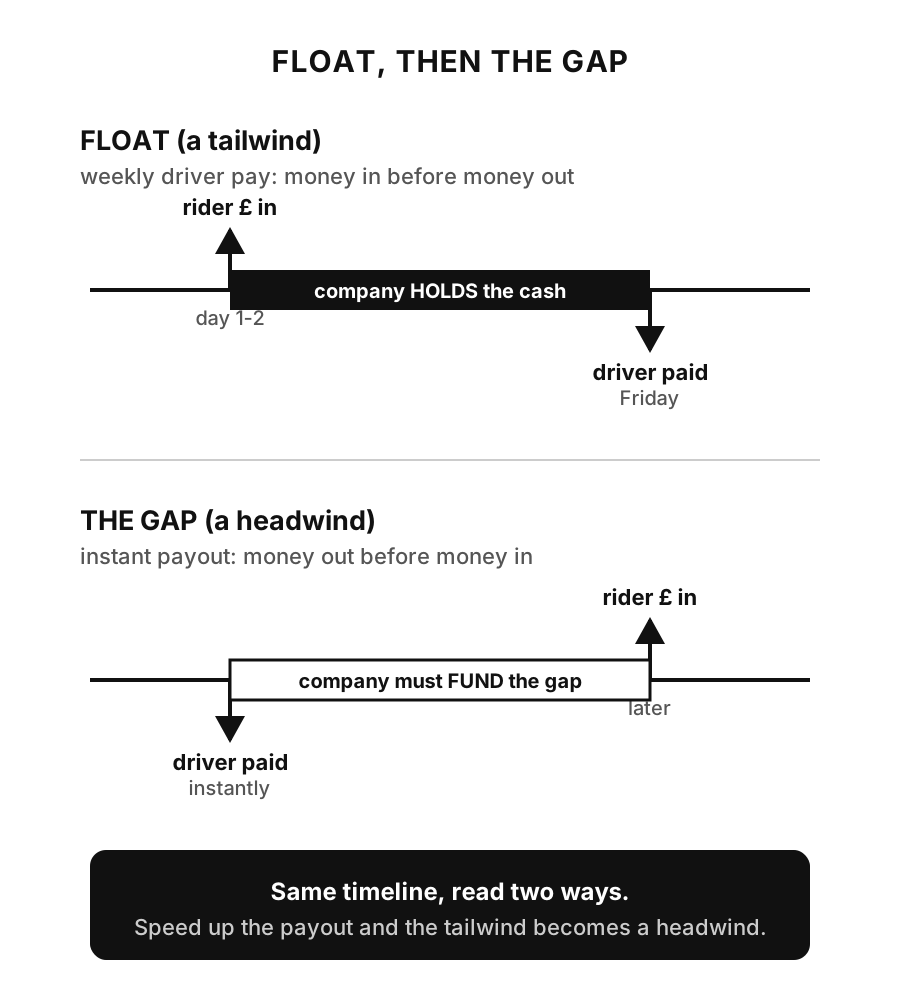
Marek is owed £8.20 for Priya's ride. Now, here's the thing most people get backwards. RideNow doesn't pay Marek tonight. It pays its drivers once a week. The rider's money lands in a day or two; the driver gets paid on Friday. So for most of the week RideNow is actually holding cash it owes to drivers. That's a nice position to be in. Money in before money out. Treasurers call this float, and a growing marketplace can run on it like a tailwind.
Until the day RideNow decides to compete on speed. A rival launches "get paid the instant your ride ends," drivers love it, and now RideNow has to match it. The moment it pays Marek before the rider's £11.40 has settled, the tailwind flips into a headwind: RideNow is fronting the cash, lending to itself to bridge the gap. That gap has a name we'll obsess over later: working capital. Multiply one instant payout by two hundred thousand drivers and a two-day settlement lag and you get a number large enough to strain a company that's technically profitable. RideNow will one day pay a bank a great deal of money to make that gap smaller. On Tuesday, the whole question was £8.20 and nobody was even thinking about it.
And how does the £8.20 actually reach Marek? Another payment, running the opposite direction. RideNow instructs its bank to send money to Marek's bank over the payment rails (the shared plumbing banks use to shove money between each other). In the UK that can clear in seconds. In the countries RideNow hasn't entered yet, "pay the driver" will mean a different rail, a different cut-off time, a different set of rules, sometimes a different bank entirely. Miss a local cut-off and a driver waits days for money he's already earned, and drivers who wait for their money quit. "Pay everyone instantly, everywhere" sounds like a feature. It's actually years of infrastructure.
What the first payment was really hiding
Put the three pictures back to back. A promise that travels in a second and money that follows a day or two later (Figure 1.1). A chain of seven parties who each take a cut and trust no one (Figure 1.2). And a bucket of cash that knows a total sitting next to a memory that knows whose money is whose, the two of them drifting apart unless someone works to keep them equal (Figure 1.3). One authorisation, one settlement, one bucket, one memory. On a single ride worth less than a sandwich.
Now do it forty million times a day, in dozens of currencies, under dozens of sets of laws, while a regulator watches and a board asks why the cash forecast is wrong. That's my job. That's this book.
The founders didn't know any of this was there. They just saw £11.40 arrive and thought: it works. And it did work, for a while, which is the most dangerous phase of all, because everything you don't understand is still small enough to ignore.
It won't stay small.
A transaction banker looking at week-four RideNow doesn't see forty rides a day. They see the trajectory, and they see three problems the founders can't yet name:
- Collections. How does money come in reliably, cheaply, and reconciled? The bank offers one product that lets RideNow accept cards and wallets in every country through a single connection, instead of wiring up a separate processor per market. The industry word for the acceptance side of this is acquiring, and the big global transaction banks (a Citi, a JPMorgan) sell it as a single packaged product.
- The operating account and the ledger. The bank will pitch virtual accounts, a way to give each rider segment or business unit its own account number, all funnelling into one real account, so incoming money arrives already tagged with whose it is. That takes a huge bite out of the bucket-versus-memory matching. It doesn't erase it: refunds, chargebacks, partial payments, and fees skimmed in transit still land in an exception queue someone works every morning. That someone, years later, is Tomas.
- The working-capital gap. The day RideNow offers instant driver payout, paying drivers ahead of settled rider money becomes a financing need. It looks tiny now. The bank is patient. It knows that gap grows with the business and that one day RideNow will pay to close it.
How would the bank price this? Mostly not on the £11.40. A little on each transaction, a spread on any currency conversion, a margin on the cash sitting in the account overnight, and fees on the financing later. Banks rarely get rich on the visible fee. They get rich on the flows and the balances around it. Remember that.
Which specialists show up? A payments salesperson first, because that's the bleeding need. Behind them, quietly, a liquidity specialist (the overnight-cash and stuck-money problem) and a working-capital financing specialist (that driver-payout gap, financed against the money riders already owe) are reading the company's growth like a weather forecast.
Three Perspectives
Before the next chapter, sit with Tuesday's £11.40 from three chairs:
- If you were the Treasurer: the money lands in one London account. What is the first question you ask that a founder wouldn't?
- If you were the relationship banker: you have one meeting with these founders. Which single product do you lead with, and why that one and not the others?
- If you were the CTO: the ledger is a spreadsheet updated by hand at night. What breaks first as rides go from 40 a day to 40 a second?
The mental model (review in 60 seconds)
- A card payment is a promise first (authorisation), money later (settlement). They are two separate events. Never confuse them.
- A bank account is a bucket that knows a total. The ledger is the company's memory that knows whose money is whose. Reconciliation is keeping them equal.
- Riders' money in before drivers' money out is float, a tailwind. Offer instant driver payout and it flips into a working-capital gap the company must finance. Both scale with the business.
- The first account you open silently constrains every country you enter next.
Everything after this is the same heartbeat, louder.
The Money That Couldn't Move
"Eight months after Priya's ride, RideNow had a problem most companies would kill for. It was making too much money in the wrong place." How does a company drowning in cash nearly miss its own payroll?
Twelve more chapters. Trapped cash, FX, liquidity, working capital, custody, a bank failure, and the Sunday the rules changed.
Keep Following the Money