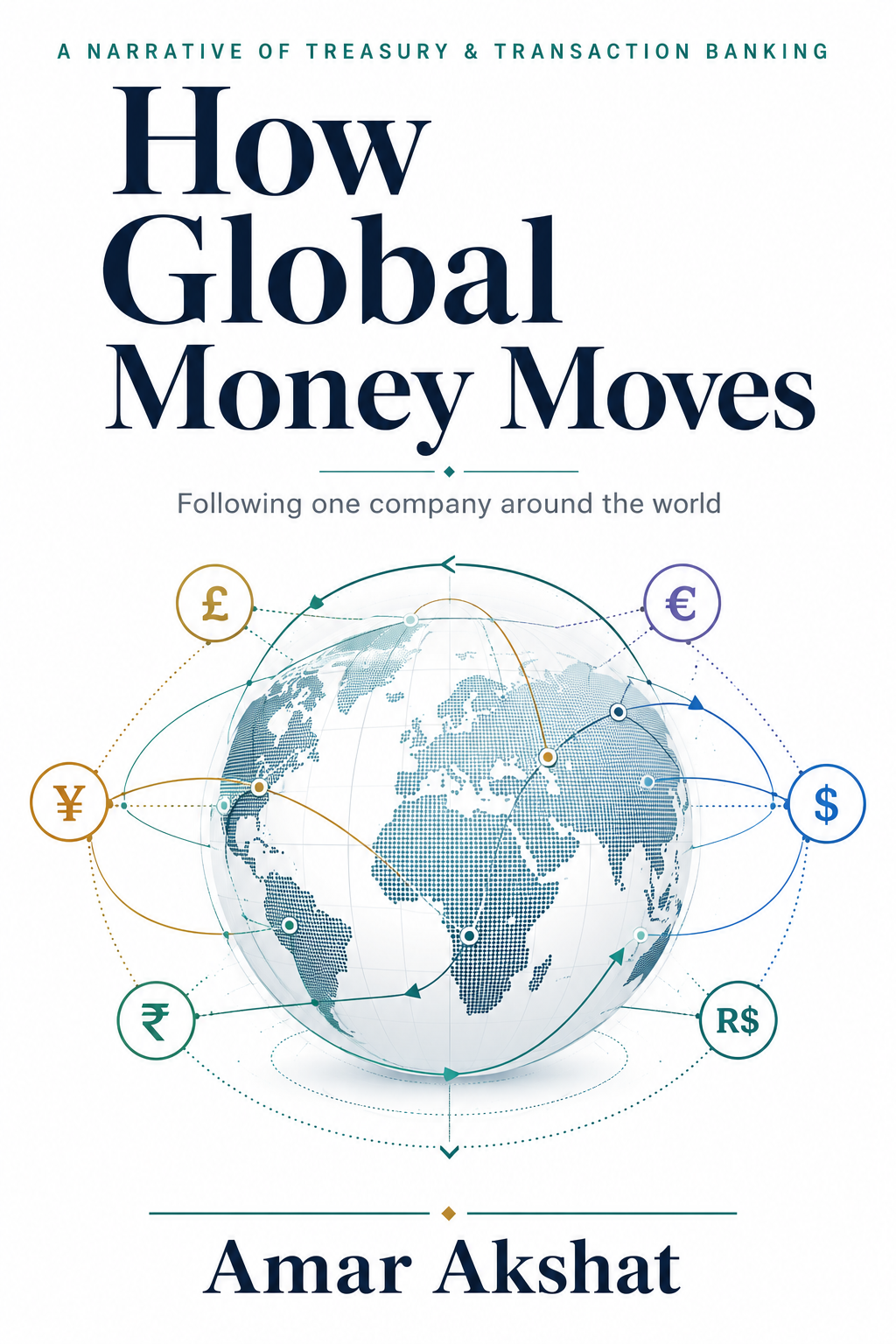
Overnight the company collected ¥2.8 billion in Tokyo, €48 million across Europe and £31 million in London. Payroll in Brazil is due in four hours. A German supplier expects payment by noon. The cash is all there. It's just scattered across dozens of accounts, in currencies that don't match the bills, in countries that don't want to let it leave.
Global business runs on a machine almost nobody has seen whole: rails, treaties, cut-off times and 2 a.m. decisions that move the right money to the right country before the day begins. This book opens the panel.
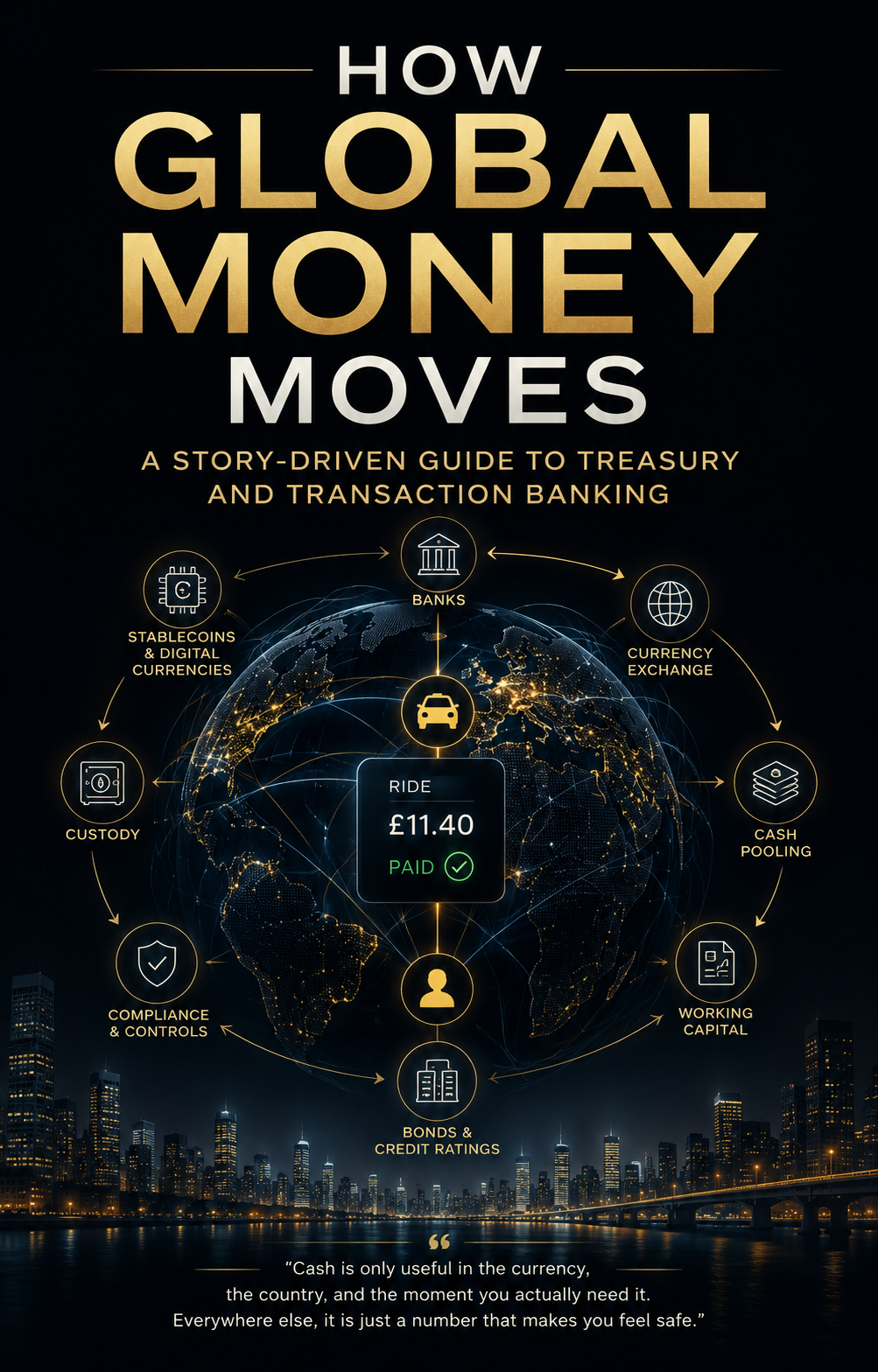
How Global Money Moves is transaction banking taught as a story instead of a textbook. You follow RideNow, a fictional startup that grows from one £11.40 ride in Camden into a company moving billions across the planet, with its Global Treasurer as your narrator.
Every concept arrives the way it does in real life: as a problem. Cash trapped in Brazil. Payroll due in a currency nobody holds. A bank that fails on a Thursday. Money that suddenly moves on a Sunday. You learn pooling, netting, FX, custody, working capital and reconciliation because the story forces someone to need them, right now, before noon.
No products to memorise. One idea to keep: follow the money through its whole life, and everything in global banking becomes the obvious answer to a problem you have already lived.
One woman. One cab. £11.40. Everything the company will later spend millions to fix is already hiding inside this single payment. Read the whole chapter free, with all three figures.
I want to start with a confession, because it will save you a hundred pages of theory.
When I joined RideNow as Global Treasurer, the company was already in eleven countries and moving close to two billion dollars a year. It looked, from the outside, like a machine. From the inside it was held together with spreadsheets, good luck, and a man named Tomas who was the only person who understood where the money actually was.
So before I show you the machine, let me show you the day it didn't exist yet: the day RideNow made its first eleven pounds and forty pence…
Seven questions. Every one of them looks easy. Most people who work in tech get four wrong. Here is the £11.40 you're about to follow:
"I've sat through twenty years of payments strategy decks and none of them explained the plumbing as clearly as one fictional cab ride. I gave a copy to every new joiner on my leadership team. It's the onboarding book our industry never had."
"Bankers explain products. This book explains problems, and suddenly the products make sense. The chapter on trapped cash is the single best client-conversation primer I have read. I now hand it to relationship managers before their first corporate call."
"The Banker's View sections are quietly brilliant. You watch the same scene twice, once from the treasury desk and once from our side of the glass, and you finally see why each side behaves the way it does. Accurate enough to make an insider wince, readable enough for anyone."
"Fifteen years in treasury and this is the first book I could give my family to explain what I actually do all day. The bucket-and-memory picture of reconciliation is now how I explain it to auditors too. I wish someone had handed me this on day one of my career."
Thirteen chapters. One company. One question you'll never un-ask: where is the money, right now?
Read How Global Money Moves